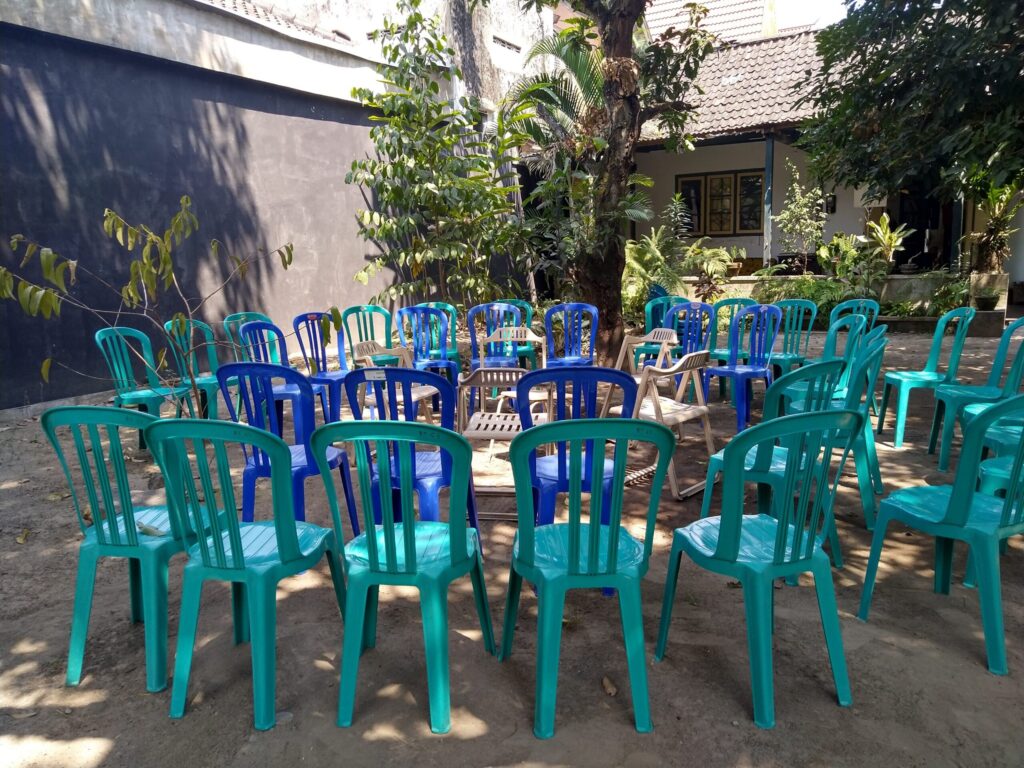
The big circle meeting during KUNCI’s 20th birthday, Yogyakarta, August 29, 2019. Image: Nuraini Juliastuti
The symposium presents IMAGINART output between 2020 and 2026, while expanding its scope through a focus on Amsterdam, the Netherlands, and the current conjuncture in order to tackle core political urgencies affecting the role cultural institutions play in society.
IMAGINART has investigated a variety of creative counter-institutions in Palestine, Italy, Hungary, Indonesia, Germany, South Africa and the Kurdish diaspora. These are artist-run, mostly grassroots spaces and projects that set up socio-institutional experiments based on principles of collaboration, horizontality and resource sharing. These projects mobilize artistic practices to reconfigure organizational forms and reimagine self-organized, collective life according to ideas of social justice and freedom.
IMAGINART’s main proposition is that these socio-artistic experiments produce an institutional otherwise in the here and now that may prefigure the future of cultural and other institutions. Thus, the symposium asks: What does it mean to ‘imagine institutions otherwise’ in this moment? What are meaningful responses to the ongoing fascist attack on cultural institutions? How do counter-institutions propose to change our organized ways of being and working together? Can their tentative proposals, their lessons in the minor key, show how cultural institutions could emerge from the current polycrisis?
Panels:
1. Cultural institutions in times of genocide
2. How do counter-institutions work: The promise of the minor key
3. Practitheorizing: Utopia, the otherwise and the radical imagination
4. The neofascist conjuncture: What is to be done?
Participants include: Mohamed Abusal, Jessica de Abreu, Reza Afisina, Amal Alhaag, Barnita Bagchi, Sruti Bala, Selçuk Balamir, Marco Baravalle, María do Mar Castro Varela, Luke Cohlen, Jamila Ghaddar, Lani Hanna, Jeanne van Heeswijk, Aline Hernández, Lara Khaldi, Jeroen de Kloet, Christa-Maria Lerm Hayes, Hilda Moucharrafieh, Nawal Mustafa, Emily Pethick, Josien Pieterse, Omar Salamanca and Mikki Stelder.
IMAGINART members: Chiara De Cesari, Andrea Elera Coello, Nuraini Juliastuti, Yazan Khalili, Abdulkerim Pusat, Eszter Szakács, Aria Spinelli, Jasmijn Stam, and Carine Zaayman
View the program here